ECO GREENHOUSE
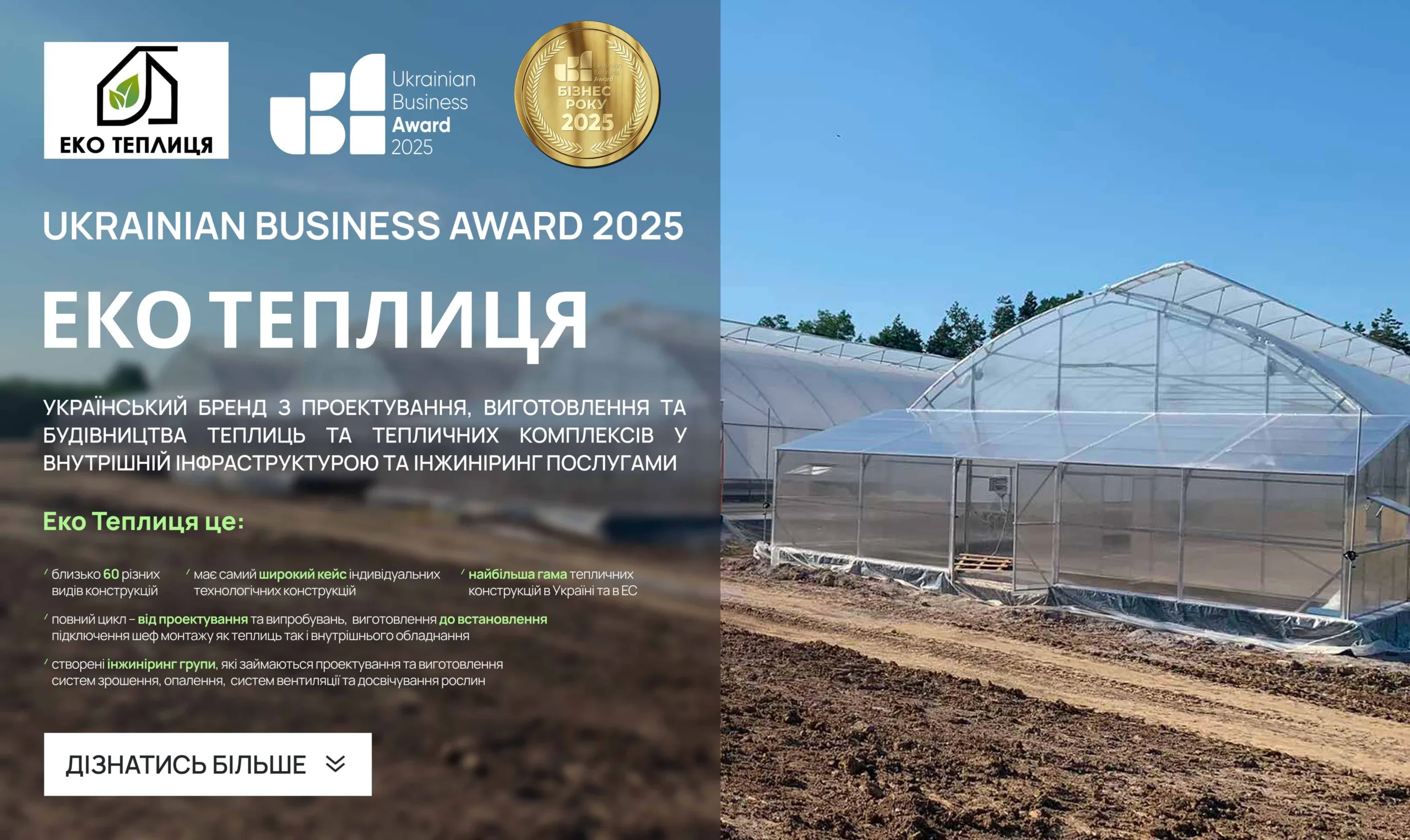
Eco Greenhouse is the winners of the Ukrainian Business Award 2025 in the nomination “Greenhouse Manufacturers in Ukraine”

Eco Greenhouse is a Ukrainian brand for the design, manufacture and construction of greenhouses and greenhouse complexes in internal infrastructure and engineering services. And the main task is to create modern greenhouses and greenhouse complexes that meet modern trends.
Eco Greenhouse as a brand appeared in 2012 as a small company of two workers, as is often the case, which at first simply assembled small summer cottage greenhouses and provided installation services. But gradually, as is usually the case, they began to make greenhouse designs in a regular garage, which they then drove and installed.
The next important step is to understand the complete process and the needs that are necessary for greenhouse growers, because in addition to the greenhouse itself, it also requires irrigation, ventilation and plant testing systems. All this allows us to understand the client’s needs and close it as turnkey as possible.
In 2014, the first warehouse and production areas with various mechanical equipment appeared, which made it possible to create competitive designs and have weight in the market among greenhouse growers.
In 2018, ECO GREENHOUSE is already a well-known company that builds greenhouses and greenhouse complexes throughout Ukraine, a large number of installation teams installed greenhouses from Transcarpathia to Donetsk region.
2019 TM ECO GREENHOUSE manufactures about 60 different types of structures and has the widest case of individual technological structures. Engineering groups have been created that are engaged in the design and manufacture of irrigation systems, heating, ventilation systems and plant testing. One of the main tasks is to create a “general greenhouse system” so that it works not as separate systems – but as a single working mechanism in the greenhouse to create and control the optimal microclimate in greenhouses. Currently, a large number of research and testing of equipment and structures is being carried out to create a modern basis, since what was before this is the basis of the approach from Soviet times and is no longer suitable because modern approaches require energy efficiency, increased productivity and yield. At that time, cooperation with the National University of NUBiP began, where on their botanical garden territory we built a greenhouse laboratory using Mitlider technology, in which we conducted experiments and graduate students prepared their dissertations there, and this greenhouse laboratory worked as an ideal option for training future agronomists.
2020 ECO GREENHOUSE begins to supply the first greenhouses for export, the first countries were the Baltic countries and Moldova. There were trial exports to Azerbaijan, but the logistics complexity due to the long distances and the proximity of Turkey, where the greenhouse industry is also developed.
In 2022, despite the difficult conditions of the beginning of the war and the unpredictability of the future, we will open a second production facility in the fall, which specializes in the manufacture of additional equipment for greenhouses in addition to the manufacture of structures. There, we have begun manufacturing a line of different capacities of new and unique air heating boilers for greenhouses, which, by the way, also work perfectly in hangars, warehouses and industrial premises where large volumes of air need to be heated quickly.
At the moment, ECO GREENHOUSE has the largest range of greenhouse structures in Ukraine and the EU, has a full cycle – from design and testing, manufacturing to installation and connection of the installation manager of both greenhouses and internal equipment, such as irrigation, ventilation, watering, lighting. ECO GREENHOUSE does not just manufacture and install greenhouses, but develops a ready-made solution for the greenhouse business, with a full calculation of the correct location of the greenhouse complex on site, roads, entrances, administration and other buildings, artificial lakes, a rainwater drainage system, all this is necessary so that after the completion of the greenhouse complex in two to three months this enterprise can already receive the first harvests and profits.

Why greenhouses have become more relevant than ever for Ukraine
In fact, there are many factors here:
First of all, climate change, we need to understand that over the past 20 years we have felt how the climate is changing and it has become significantly unpredictable, with anomalous temperature drops both in “+” and “-“. Moreover, over the past 10 years we can see anomalous temperature jumps, for example, in January we can see +12 C. And we cannot predict summer at all – low temperatures in the summer, for example, in 2017 in Chernihiv region in June it was minus 1.1 C! There were a lot of minimums in the range of +2 -+5 C in the 20s throughout Ukraine, and at the same time we also see records for maximum temperatures in +, for example, in 2024 in Mykolaiv there was another temperature record in July + 41.6 C.
In addition, we no longer consider diseases, pests, insects (we all heard this year about locusts, which were a disaster for farmers who suffered from them), acid rain and other external factors that can lead to the loss of part or all of the crop in open ground.
All this leads to the fact that open ground becomes quite risky, and the yield is unpredictable. Low temperatures, then heavy rains, then a dry period are very dangerous for heat-loving plants. That is why more and more farmers are gradually starting to increase the area of closed ground. This is primarily predictability.
Secondly, it increases the efficiency of using the area. The point is, because only when creating an area of closed soil, that is, when we simply cover the open soil with a film, for example, and create a simpler tunnel, can we increase the yield by 294%.
Here, for example, is a small comparison of the yield of open and closed soil
| Culture | Open ground (medium) | Open ground (maximum) | Year-round greenhouse (medium) | Year-round greenhouse (maximum*) |
| Tomatoes | 3 – 5 kg | 7 – 8 kg | 25 – 40 kg | 60 – 100 kg |
| Cucumbers | 3 – 4 kg | 5 – 7 kg | 30 – 45 kg | 70 – 120 kg |
And although we need to understand that the maximum indicators are achieved in modern industrial greenhouses with high-tech equipment (lighting, CO₂, keel culture) and in Ukraine, let’s say, such indicators are obtained only in laboratory conditions, however, modern technologies already allow us to come very close to these parameters.
In the third, unfortunately, we have now lost almost 40% of the area of closed soils, which are temporarily located in the occupied territory. Zaporizhia and Kherson regions on the left bank had a mild and warm climate and therefore there are villages that are simply completely covered with greenhouses. For example, Kamenitsa Dnistrovskyi can even be seen from space how everything is covered with greenhouses. Therefore, now there is a gradual restoration of areas. By the way, this is helped by a large number of grants directed to the construction of new greenhouse farms. One of the most famous is the state support “Grant for a greenhouse”, which is opened through the ACTION and this grant can be transparently and realistically obtained for the construction of a greenhouse farm.
In addition, it is necessary to understand that the development of greenhouses allows you to create a self-employed family business, and it is possible to grow on 20-30 acres of greenhouses enough to create a greenhouse business and earn money from it. This is one of the options for creating jobs for displaced people.
Not only the state, but also a large number of foreign grantors issue grants for the development of greenhouses, because this is food security and increasing the productivity of cultivation.
In addition, Ukraine is still an agrarian country, and one of the huge export items of GDP, which in recent years sometimes occupied up to 40% of total GDP exports, is our agricultural products. We have a unique climate, unique lands for growing agricultural products. The climate is getting warmer. Unfortunately, at the moment, the share of greenhouse farming in the total volume of the agricultural complex is only about 4.5%, and this is not enough. For example, in China, every third kilogram of vegetables is grown in a greenhouse. China is one of the most powerful countries in the greenhouse sector, which has more than 60% of all covered soil areas in the world. And although exports (approximately 1-2% of the total mass) of agricultural products in China are not so large, because they have a very large domestic demand and they are still a large importer of vegetable products, nevertheless, 20-30% of the total amount of agricultural exports is greenhouse products. That’s why they have 3.5 million hectares of land under closed soil (in Ukraine, for example, only 4.4 thousand hectares).
There are several other powerful agricultural countries that have large areas of closed soil – the Netherlands, Spain, Turkey. And if Spain and Turkey have a lot of sun and most of them are simple greenhouses in which they grow products en masse (by the way, in Spain there is the largest greenhouse in the world under one roof, its size is the entire area of the city of Kyiv). Then we are very interested in the experience of greenhouse farms in the Netherlands because they have some of the most technological greenhouses in the world. This is a greenhouse “flint” valley. Because the country of the Netherlands itself is slightly larger than the Odesa region. But at the same time, their export of greenhouse products alone is 12-13 billion euros, these are premium vegetables, flowers, seedlings. And at the same time, the total area of all greenhouses in the Netherlands is approximately 10,000 hectares and 80% are high-tech all-season greenhouse complexes. In Ukraine, for example, there are only 4.5 thousand hectares, and only 400 hectares are technological (300 vegetables and 100 flowers). By the way, the entire export of agricultural products in the Netherlands is under 120 billion. And this is in addition to the fact that the Netherlands is approximately 15 times smaller than our Ukraine. Therefore, if someone thinks that being an agricultural country is bad, they will look at the Netherlands, it is better than pumping oil, because firstly, this entire agricultural complex is evenly distributed throughout the country and does not create point surplus profits, and secondly, oil and gas may run out someday. I dream of a high-tech agricultural Ukraine – because Ukraine can grow a huge amount of organic products, this is a product that is always in demand.
In addition, from all of the above, the greenhouse potential of Ukraine is not currently open not only by half, but probably by 10%. Because, for example, in other agricultural countries the average % of the greenhouse industry is above 10%, and in Mexico it is 18% in general (and every second avocado we buy comes from greenhouses). In our country it is only 4.4 – 4.7%. There are less than 10% of winter technological greenhouses – and it is they who can create products with the greatest value.
Why is this a small fraction, but very important for us:
- Strategic import substitution due to the fact that unfortunately at this moment in the winter period 80-90% is imported from Turkey, Spain, Morocco. And it is necessary to create modern energy-efficient greenhouses to ensure food security during this period.
- High added value: The cost of 1 kg of greenhouse tomatoes per season can be 3-5 times higher than soil tomatoes. This is a high-margin business – provided that the cultivation technology and a permanent sales market are followed.
- Year-round supply: Greenhouses are practically the only source of fresh domestic vegetables in the winter-spring period.
- Stability: Production in greenhouses does not depend on droughts, downpours and other weather vagaries, which makes it more predictable.
What trends and prospects in the greenhouse sector are there at the moment and will there be in the near future?
- High energy efficiency of greenhouse farms – greenhouses are actually the most energy-intensive production, because greenhouses have translucent coatings, so they lose 3 times more heat compared to ordinary houses. Therefore, for example, to heat 1 ha of greenhouses, a boiler room with a capacity of 2-2.5 MW is required, and given that fuel is now quite expensive, energy-saving technologies are currently being created and implemented. For example, we are implementing the following energy-saving technologies: a double-film covering system with automatic air injection into the inter-film space – this creates an air buffer with constant air pumping. As a result, this reduces heat loss compared to ordinary single coating by more than 2 times (we reduce heat loss from 7.5 W/m2C to 3-3.5 W/m2C).
- For example, we are implementing the following energy-saving technologies: a double-film covering system with automatic air injection into the inter-film space – this creates an air buffer with constant air pumping. As a result, this reduces heat loss compared to a conventional single coating by more than 2 times (we reduce heat loss from 7.5 W/m2C to 3-3.5 W/m2C).
- We are implementing the “Heat-Cold” accumulation system, which takes excess overheated air from the upper part of the greenhouse and, distilling this hot air through the soil through pipes, accumulates all this heat in the soil – which returns excess heat to the greenhouse and uses it as much as possible at night. This allows you to reduce heating costs by 25-40% in the cold season.
- Damping systems are an opportunity to additionally curtain the upper part and sides at night – which also allows you to reduce heat loss by up to 30%.
- Already now those greenhouses that are being built are several times more economical than the old Soviet approaches to energy saving – and the share of heating costs in the cost price has decreased from 65% to 30%.
- Full automation – in our modern world, automation is already a necessity. It is being implemented everywhere – even to taxi autopilots. This should first of all be now available and easy to manage. And now we have implemented affordable systems for online control of equipment and climate in the greenhouse. And our task was to create simple and affordable control systems, if, for example, 10 years ago, an online control and management system for the entire life system of a greenhouse cost around $3,000 – $5,000, then we were able to develop simple and affordable ones for just $300 – $500 that are already based on current models – for example, on the Tuya Smart Home platform, we are now installing simple and intuitive modules that can control heating, lighting, irrigation, ventilation, everything in the greenhouse in automatic and manual mode via phone in just a few clicks and you see what is happening in yours. In addition, if any system fails, or any parameters such as temperature, humidity, or illumination exceed the specified parameters, you will receive an immediate notification. Now you can easily and practically manage your greenhouse in an automatic online mode. In addition, the transition to greenhouse automation reduces labor costs and, most importantly, increases yield – as practice shows, by 30-40% (and we also avoid errors related to the human factor).
- Increasing yields, for example, thanks to modern technologies it is possible to obtain 70-80 kg / m2 of tomatoes compared to open ground 3-5 kg / m2 and greenhouses 10-25 kg / m2, which is much more efficient.
- Creating online sales of green products. Online purchase of green products is already being tested and will be launched in the near future. You can order a “basket” of products and receive fresh products literally just a few hours after, for example, salads, tomatoes and cucumbers are picked in the greenhouse. It is already being tested that you can order products from a specific greenhouse farm – receive a “subscription” for products and see online how the products are grown, what they are fertilized with, know what exactly you are eating. Creating such a subscriber base allows greenhouse farms to have a permanent customer base and fight for the quality of products.
By the way, now IT technologies are actively entering the greenhouse business and yesterday’s programmers will have greenhouses with a high level of automation and manufacturability because it is precisely the greenhouse that is a powerful combination of a variety of technologies from agricultural ones – for cultivation, heat engineering, hydraulics, ferritization, modern approaches in hydroponics and aquaponics, combined with modern control technologies and AI make a completely different approach to greenhouse cultivation. A greenhouse sometimes reaches the level of complexity of a small spacecraft, due to the fact that it is necessary to create an ideal microclimate in a closed environment. Greenhouse technologies are now being very actively prepared for future space missions because the first thing that needs to be created on another planet is a closed cycle of biomass cultivation to provide the first astronauts who will live. We all watched the movie “The Martian” and there a lot of attention was paid to growing plants in Martian greenhouses. Therefore, greenhouses are not only the present, but also the future for humanity.
In addition, it is necessary to understand that greenhouses also have a large social role in the life of the country.
Firstly, it allows you to effectively create self-employed family farms, because greenhouses from 300 m2 can already be considered a commercial format and there it is possible to grow much more than for your own table. 1500 – 3000 m2 greenhouses allow you to grow products and sell them to provide for your family. Greenhouse complexes from 4000 m2 allow you to create a greenhouse business with hired workers that will bring in income.
Greenhouses make it easy to socialize people with disabilities because growing in a greenhouse is always creating plants and this is very well reflected in the mental state of people. At one time, we built greenhouses for people with disabilities, specially adapted the greenhouse so that such people could work there. And then we saw a video of how these people worked in these greenhouses. They felt needed and busy there.
We all understand what time we are living in now, a war, and this war is often called the drone war. In fact, the first drones that gave us a certain advantage were agricultural drones that were retrained into bombers. However, the war will end sooner or later, and I hope that the history of drones will continue in the agricultural sector. Now in Israel, drones are starting to be used in greenhouses to control plants and harvest. Having AI, these drones scan the condition of plants and vegetable products, collect data from this and transmit it to a common server. And there the nutrient solution can be adjusted depending on the condition of the plant. In addition, these drones can harvest and immediately sort vegetables depending on size and condition. Ukraine is now one of the leading countries in drones and I hope that after the war this potential will move into other areas, including the greenhouse industry.
In addition, we participate in a social project and build greenhouses for schools, because it is also important for the new generation to have a connection with nature and see how plants grow, how it all happens and maybe in the future they will want to not only do tik tok and reels, but also engage in creation and cultivation.
Our goal in general is to develop the greenhouse industry, and to create so that growing in greenhouses allows you to obtain products with low cost and organically useful. It is for this reason that we created and run, for example, our YouTube channel “ECO GREENHOUSE” and if at first it was just a presentation of greenhouses, then over time we began to talk about how to build greenhouses, what nuances need to be taken into account. All this was created to popularize the greenhouse industry, to make it easier for people to understand the path to take in order to create their own greenhouse business. And sometimes it all starts with the simplest and cheapest homemade option, in order to start from it and develop further. And as practice shows, the greenhouse business is not the easiest direction, the greenhouse itself will not grow, and what is also important is that you need knowledge for this.
We try to share our experience gained over 12 years of work in this area through our social media channels. And by the way, now for FAO (Food and Agriculture Organization, FAO) – an organization under the UN that deals with food security in the world – my colleagues and I are preparing a training course for 6 hours of video lessons of 10 minutes each, briefly everything about greenhouses, cultivation and organizational issues. This is necessary for those who will receive grant funds for the construction of greenhouses, because the first thing you need to get for the effective use of funds is knowledge or, as they say, a “road map” of how and where to move to get results.
I hope that over time we will be able to develop such greenhouse technologies that the cost of products in greenhouses will be the same or lower than in open ground. In this case, we will be able to enjoy green, fresh and healthy products all year round.